

It is a Thursday night and you are setting up a Facebook ad for a new three-bedroom listing. You go to pick your audience and try to narrow it to families with kids in a couple of nearby ZIP codes. The options are gone. Meta has forced your ad into the Housing Special Ad Category, and half the targeting you used last year has vanished. Annoyed, you write a headline instead: “Perfect family home in a safe neighborhood.” You just traded a platform rule you can survive for a federal violation that can cost tens of thousands of dollars.
Real estate ads on Facebook and Instagram follow two separate rulebooks at once, and most agents know only one. Meta controls who you are allowed to target. The Fair Housing Act controls what you are allowed to say. Break the first and your ad gets rejected. Break the second and you face a HUD complaint, a lawsuit, and a penalty that dwarfs any commission. Here is the plain-English version of both, the targeting you lose, the words that get agents in trouble, and sample copy you can run.
Table of contents
- Why real estate ads follow two rulebooks at once
- What the Fair Housing Act bans in advertising
- What the Housing Special Ad Category takes away
- How we got here: a short timeline
- The words that get real estate agents fined
- Compliant vs non-compliant ad copy, side by side
- What a violation actually costs you
- Three scenarios: solo agent, small team, brokerage
- Steal this: compliant ad copy and a targeting setup that still works
- Objections
- Frequently asked questions
Why real estate ads follow two rulebooks at once
The “who” rule is Meta’s. Facebook and Instagram run housing, employment, and credit ads through a restricted system called the Special Ad Category. You do not opt in. The moment your ad is about a home for sale or rent, Meta classifies it as housing and strips out targeting tools that could exclude protected groups. Get it wrong and your ad is disapproved or your account flagged.
The “what” rule is federal. The Fair Housing Act applies to anyone who makes, prints, or publishes a housing ad: your Facebook post, your Reel caption, your flyer, your MLS remarks. It does not care whether Meta approved the ad, only whether the words indicate a preference based on a protected class.
Here is the trap. When Meta removes your targeting, the instinct is to make up the difference in the copy, telling the reader exactly who the home is for. That is the most common way a compliant-looking ad becomes illegal.
What the Fair Housing Act bans in advertising
The advertising rule lives in 42 U.S.C. 3604(c). It is unlawful to publish any ad about the sale or rental of a dwelling that “indicates any preference, limitation, or discrimination” based on a protected class. The key word is “indicates.” You do not have to intend to discriminate; if the ad signals a preference, it violates the law.
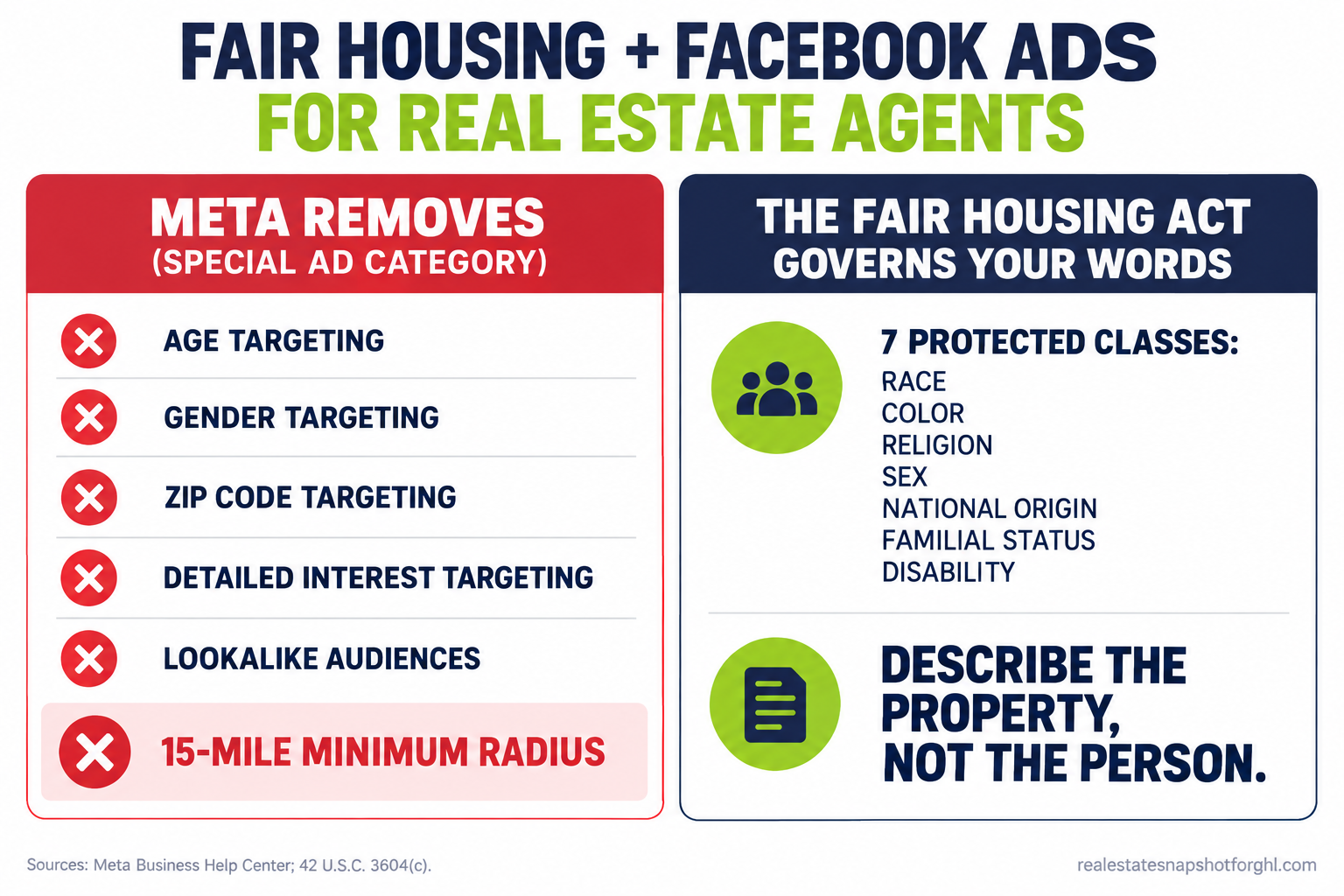
There are seven federal protected classes: race, color, religion, sex, national origin, familial status (families with children under 18), and disability.
Since 2021, HUD enforces discrimination based on sexual orientation and gender identity as a form of sex discrimination, following its February 2021 memorandum applying Bostock. Many states and cities add their own classes, such as source of income or marital status, so local rules can be stricter than the federal floor.
The rule applies to the whole ad, not just the targeting. A caption, an image, even the audience you exclude, can each “indicate a preference.” The safe habit: describe the property, never the person who should live in it.
What the Housing Special Ad Category takes away
When your ad enters the category, Meta removes or restricts the following, per its Business Help Center:
- Age. You cannot narrow by age; the audience is fixed to all adults, 18 through 65 and older.
- Gender. You cannot target men or women. All genders are included.
- ZIP code. You cannot target or exclude by ZIP or postal code, or drop a tight radius on a single neighborhood.
- A 15-mile minimum radius. Any location you pick, a pin, an address, or a city, expands to a minimum radius of 15 miles (about 24 kilometers), so you cannot farm a single subdivision.
- Detailed targeting. A large block of interest, behavior, and demographic options tied to protected characteristics is removed, including income brackets, “likely to move,” and net worth.
- Lookalike audiences. Standard lookalikes are unavailable for housing ads. The old “Special Ad Audience” workaround that replaced them was itself discontinued in 2023 (more below).
What you keep is broad location, language, and a narrow set of general interests, the same for every agent competing against you. The ones who still win on Meta stopped trying to out-target and started to out-create and out-follow-up.
How we got here: a short timeline
The Special Ad Category exists because Facebook’s platform was used to exclude protected groups from housing ads, and civil rights groups and the government forced the change.
- •Aug 2018
First fair housing complaint
Civil rights groups allege Facebook's targeting tools let advertisers exclude protected groups from housing ads.
- •Mar 18, 2019
Facebook settles with civil rights groups
NFHA, the ACLU, and CWA settle. Facebook agrees to a separate portal for housing, employment, and credit ads and to remove age, gender, and ZIP targeting.
- •Mar 28, 2019
HUD charges Facebook
HUD files a formal Charge of Discrimination for enabling housing discrimination through its ad platform.
- •Jun 21, 2022
DOJ settlement and the VRS
The DOJ settles with Meta and requires a Variance Reduction System to shrink the gap between an ad's eligible and actual audience by sex and estimated race.
- •2023
Special Ad Audiences discontinued
Meta drops the Special Ad Audience tool because its algorithm still considered protected characteristics.
The upshot: the DOJ agreement, announced June 21, 2022, put a machine-learning system between your ad and its audience. Even with a compliant, broad audience, Meta’s Variance Reduction System adjusts delivery so the people who see a housing ad better match the eligible population by sex and estimated race. You cannot turn it off, one more reason targeting is not where your money goes.
The words that get real estate agents fined
Targeting is Meta’s to enforce; your copy is yours. The Fair Housing Act reaches every word, almost always well-meant marketing language, and the reproduced HUD advertising word list circulated by many MLSs is the classic reference for what to cut.
One rule covers most cases: write about the house, not the household. Describe rooms, finishes, lot size, and location. Never describe who the home is “perfect for,” because that describes the buyer and almost always implicates familial status, age, or another protected class.
A few specific traps:
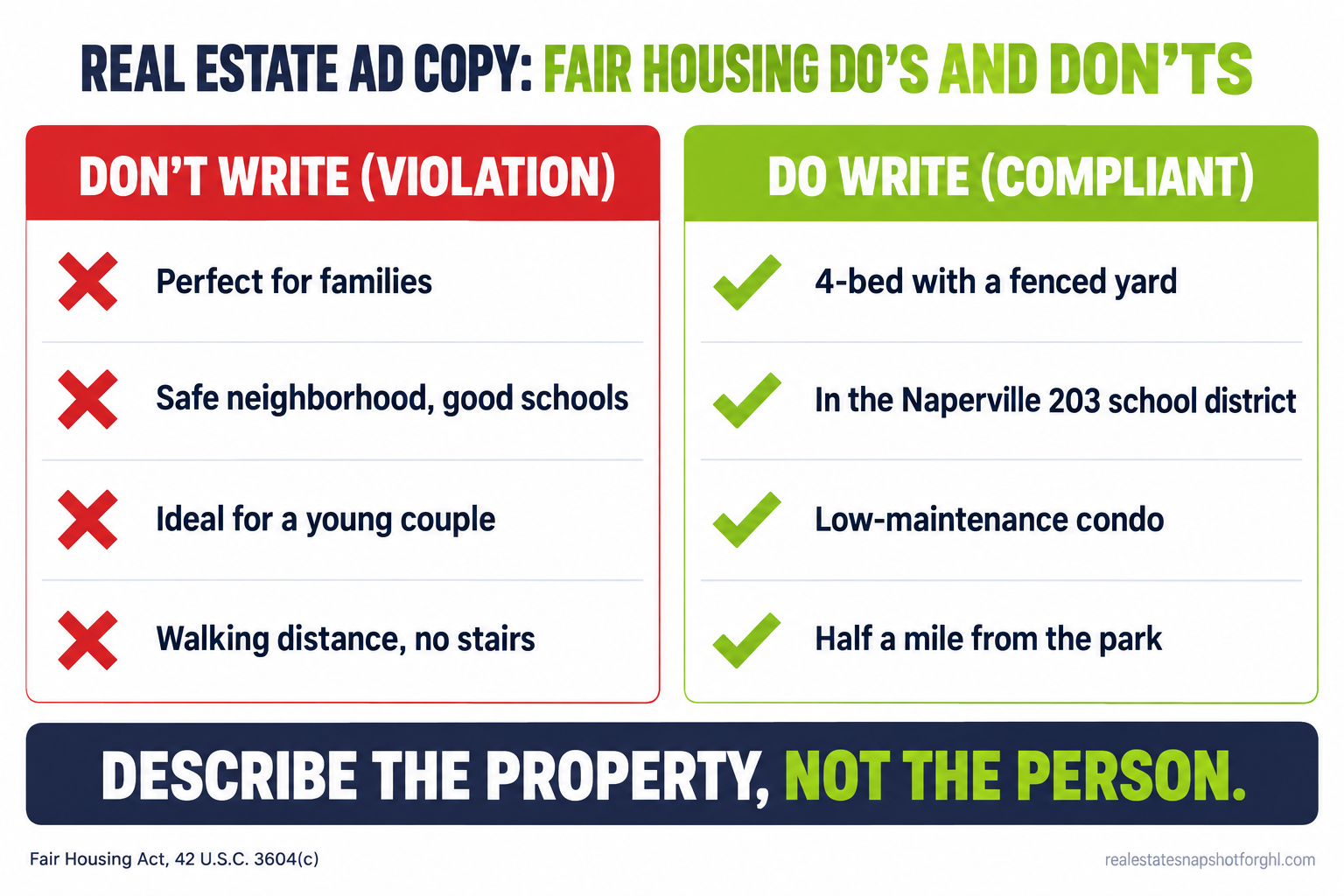
- “Perfect for families,” “great for kids,” “ideal for a young couple,” “empty nesters,” “bachelor pad.” All signal a familial-status or age preference. Cut them.
- “No children,” “adults only,” “mature community.” Direct familial-status violations unless the property is legal senior housing, a narrow, documented exception, not a vibe.
- “Safe neighborhood,” “good schools.” These read as harmless, but both have long been treated as coded steering language. Use objective facts instead, like a named school district or public crime statistics.
- “Walking distance,” “must climb stairs.” These can exclude people with mobility disabilities. Prefer “close to” or “half a mile from.”
- Religious references, such as “near St. Mary’s” or “Christian community.” Name the cross street, not the church.
None of this makes your ad boring. “Renovated three-bed, south-facing yard, two blocks from the Blue Line” beats “perfect family home” and never gets a complaint.
Compliant vs non-compliant ad copy, side by side
| Non-compliant (rewrite it) | Compliant (run it) | |
|---|---|---|
| Family angle | Perfect family home in a safe neighborhood | 4-bed, 2-bath with a fenced yard and finished basement |
| School angle | Great home for kids, top-rated schools | Located in the Naperville 203 school district |
| Location angle | Christian community, quiet and safe | Two blocks from Lincoln Park, near the 22 bus line |
| Accessibility | Not suited for anyone who can't do stairs | Two-story layout, primary bedroom on the second floor |
| Senior angle | 55+ adults only, no children | Single-level living, only for a verified senior housing community |
The left column tells the reader who should live there; the right tells them what the home is. One draws complaints, the other draws showings.
What a violation actually costs you
Fair housing penalties are not a warning letter. They come on two tracks, both expensive.
The administrative track runs through HUD. As of the 2025 civil penalty adjustment, a first violation carries a maximum around $26,262, rising for repeat conduct. The pattern-or-practice track runs through the Department of Justice, where a first violation can reach roughly $131,308 and subsequent violations up to $262,614. A complainant can also recover actual and punitive damages plus attorney’s fees.
Maximum federal civil penalties for Fair Housing Act violations, in US dollars, 2025 adjustment. Source: Federal Register, 2025 civil monetary penalty adjustment; overview via the Housing Equality Center.
The median existing-home price was $429,100 in August 2026, with sales at a 3.98 million annual pace, down 2.0 percent (NAR). One compliant ad might earn a commission on a deal that size. One non-compliant sentence can cost several times that, plus your reputation and, in many states, your license. And you do not need a real buyer to complain: fair housing testers actively monitor advertising, and a screenshot of “perfect for families” is enough to open a file.
Three scenarios: solo agent, small team, brokerage
The right defense changes with the size of your operation.
The solo agent. Your risk is copy, not systems. Your defense is a habit: before you publish, reread the ad and ask whether any word describes a person instead of the property. Keep a two-line rewrite list so “perfect family home” auto-corrects to “4-bed with a fenced yard.” Do not build custom exclusions. Compete on speed and follow-up.
The small team (2 to 10 agents). Your risk multiplies because others post in your brand’s name, and one sloppy caption is the team’s liability. Add a single approval step: every paid ad goes through one person who checks copy against the do-not-say list. Standardize a listing-ad template so the compliant structure is the default, and train new agents on the protected classes in week one.
The brokerage. Your exposure is pattern-or-practice, the expensive DOJ track, because many ads across many agents can show a systemic problem. Your defense is process and records: a locked ad template, compliance sign-off on paid campaigns, a log of what ran, periodic audits, and recurring fair housing training. A firm that can show a real program is far better positioned than one that cannot.
Steal this: compliant ad copy and a targeting setup that still works
Adapt these to your market and your broker’s review.
Since you cannot target the person, make the ad find them. Three moves do that, none touching a protected class:
- Let the creative do the targeting. A specific listing, price, and block naturally attract people shopping for that kind of home there, and Meta optimizes delivery toward people likely to act. A precise, honest ad is self-selecting.
- Retarget your own database, legally. Upload your contacts as a custom audience and retarget people who visited your site or engaged with your page. This warm sphere is where paid social pays off. See real estate database reactivation for how to rebuild that list.
- Win the follow-up. Speed-to-lead beats targeting. A lead generated at 11pm and answered at 9am is cold. An automated first text inside 30 seconds, then a real sequence, converts traffic your ad already paid for. Our Facebook ads lead-gen playbook covers the campaign side; this is the operational half.
The honest answer to “how do I reach buyers now” is a better offer and a faster response, not a narrower audience. For the sibling rules on contacting those leads, see is texting real estate leads legal, and for co-marketing with lenders, RESPA Section 8 for real estate agents.
Objections
“This is political correctness. My ad said ‘family home’ and nobody was hurt.” Intent is not the test. The law bans language that “indicates a preference,” and a tester does not need to be a real buyer to file a complaint. “I didn’t mean it” is no defense.
“Everyone in my market still targets by ZIP and age. Why should I stop?” Most cannot, because Meta blocks it for housing ads. The ones who found a workaround are running the exact behavior the DOJ sued over. Copying a competitor’s risk is not a strategy.
“I am not technical. This sounds like a legal minefield.” It is one rule and one habit. The rule: describe the property, not the person. The habit: reread every ad before it publishes and cut any word aimed at a type of buyer. For anything structural, like a senior-housing exemption, ask an attorney once.
“If I can’t target, isn’t Facebook a waste of money now?” No, it changed. Creative, offer, and follow-up carry the ad now, and the algorithm handles delivery inside the rules. Agents who upgraded those three things get cheaper leads than ever.
The Thursday-night ad from the top had a ten-second fix: change “perfect family home in a safe neighborhood” to “renovated 3-bed with a fenced yard, two blocks from the park.” Same listing, same budget, zero legal exposure, better ad. Get the words right and build the follow-up behind them, and Facebook and Instagram are still two of the best places an agent can spend a dollar.
Frequently asked questions
Frequently asked questions
What is the Facebook Special Ad Category for real estate?
A restricted category Meta applies automatically to housing, employment, and credit ads. For real estate it removes age, gender, and ZIP targeting, blocks most detailed interest targeting, disables lookalikes, and forces a 15-mile minimum radius. You cannot opt out.
Can I target buyers by ZIP code or age on Facebook for a real estate ad?
No. Once an ad is classified as housing, Meta removes age and gender targeting and blocks ZIP or tight neighborhood targeting; the smallest location is a 15-mile radius. Rebuilding that targeting through exclusions or custom audiences can itself violate fair housing law.
What words are illegal in a real estate ad?
Any word that indicates a preference for or against a protected class: avoid 'perfect for families,' 'great for kids,' 'adults only,' 'safe neighborhood,' 'good schools,' 'walking distance,' and religious references. The rule is to describe the property, not the person who should live in it (42 U.S.C. 3604(c)).
What are the penalties for a Fair Housing Act advertising violation?
As of the 2025 federal adjustment, a first HUD administrative penalty is around $26,262, and DOJ pattern-or-practice cases reach roughly $131,308 for a first violation and $262,614 for repeats, plus actual and punitive damages and attorney's fees. Some states can also act against your license.
How do I reach the right buyers if I can't target them?
Let the creative target for you with a specific listing, price, and location; retarget your own website visitors and uploaded database as custom audiences; and win on follow-up speed. A precise, honest ad plus a fast automated response beats narrow targeting.
Does the Fair Housing Act apply to organic posts, not just paid ads?
Yes. The advertising rule covers anyone who makes, prints, or publishes a housing ad, including organic posts, captions, Reels, flyers, and MLS remarks. The same 'describe the property, not the person' rule applies everywhere you promote a listing.
This article is a plain-English operator’s guide and is not legal advice. The Fair Housing Act is federal, and many states and cities add protected classes and stricter rules. Meta changes its Special Ad Category policies without notice; confirm current rules in its Business Help Center. Before relying on any exemption, such as senior housing, have a qualified real estate attorney review your situation.